

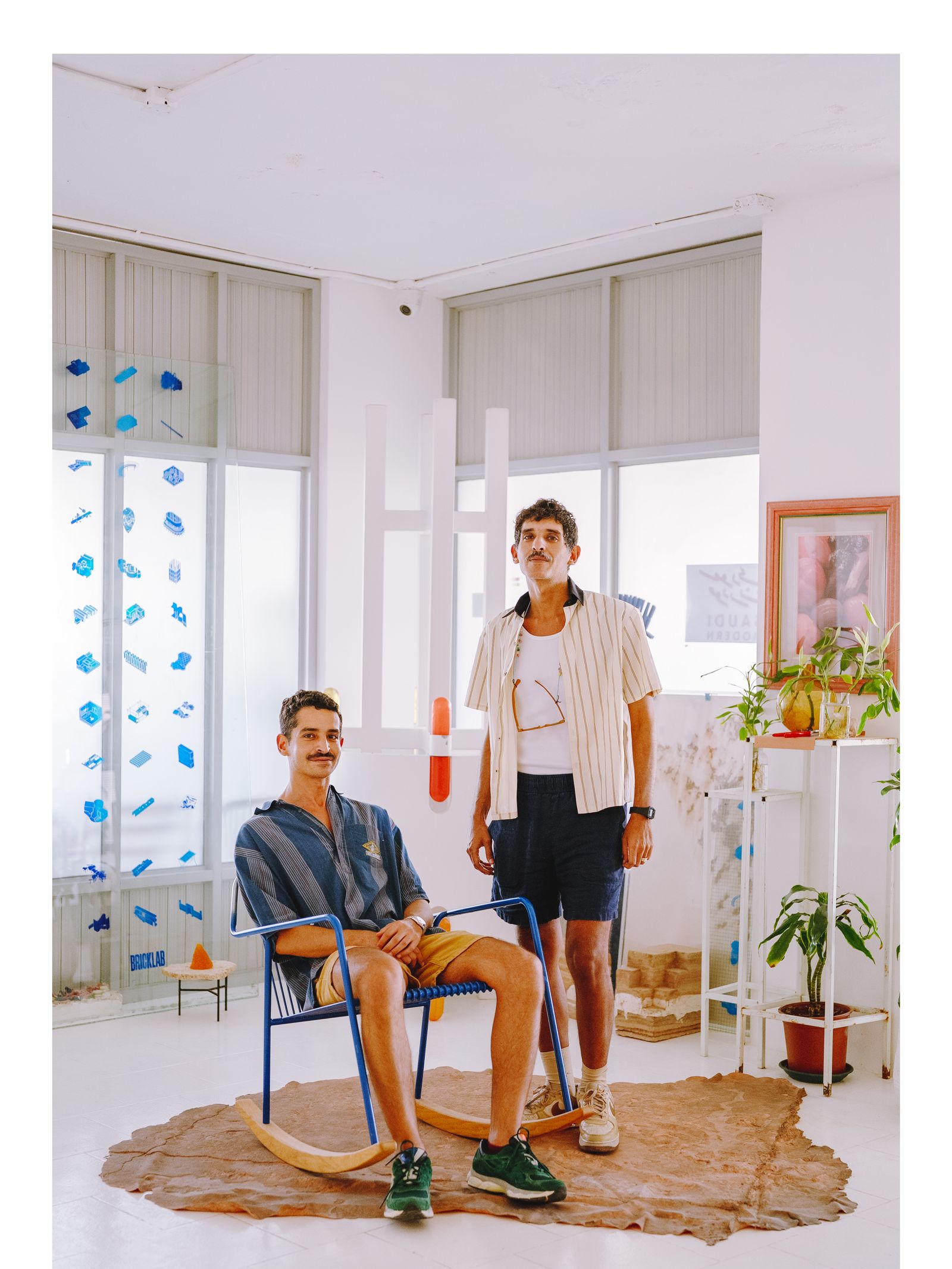
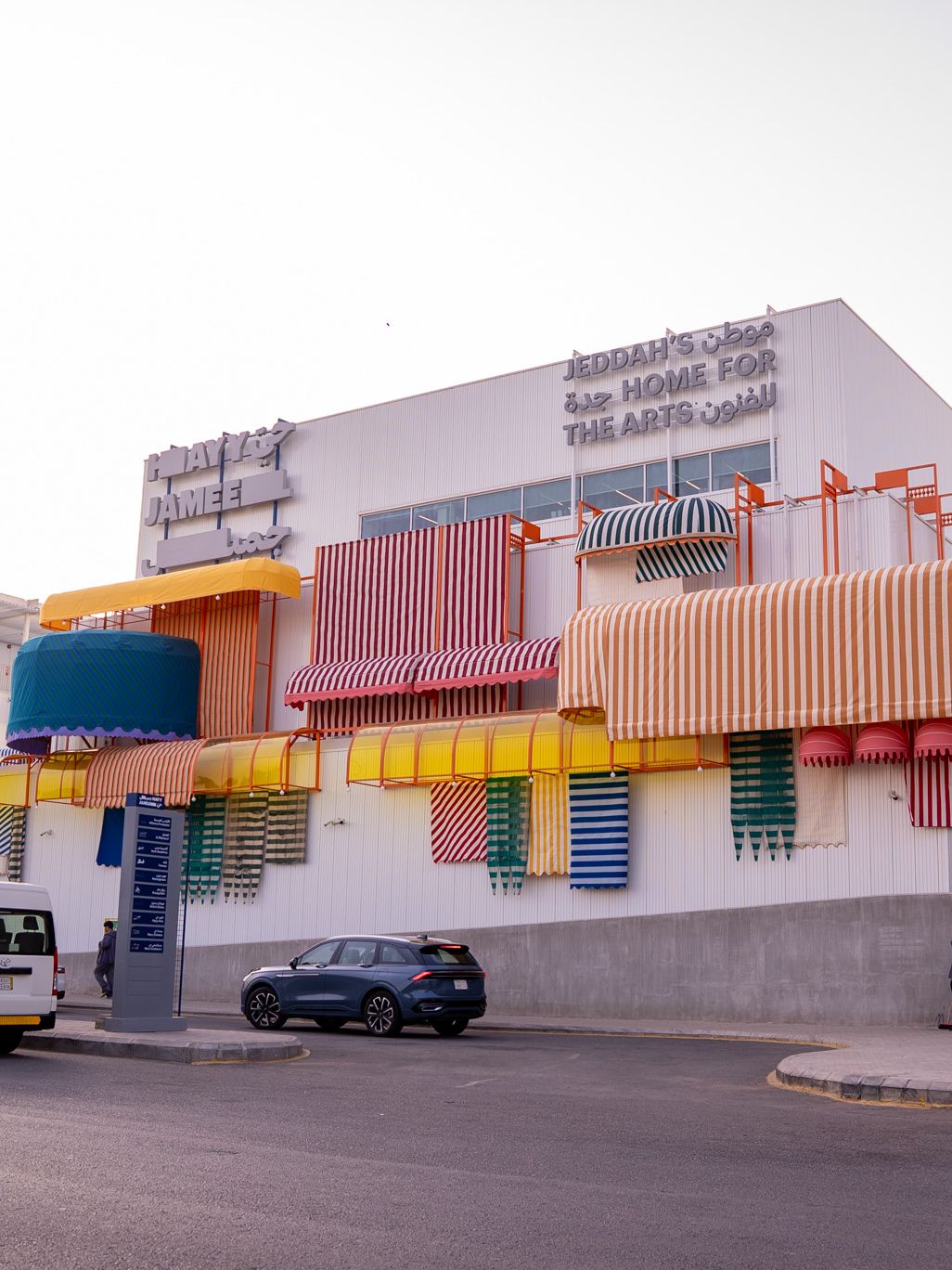
With Hayy Jameel's Spring 2026 arts programme kicking off in May, the Saudi studio led by brothers Abdulrahman and Turki Gazzaz, has taken over the arts complex's light corrugated facade with a joyfully vibrant patchwork of striped fabric canopies. Tasked with delivering the fifth annual Facade Commission, the Jeddah-based architecture and urban research practice looked to one of Jeddah's most familiar urban fixtures for their intervention, bringing a fragment of the city's everyday streetscape onto one of its most prominent cultural institutions.
The intervention is also a playful nod to the institution's core ethos and its name, Hayy, which translates from Arabic as “neighbourhood”, feeling right at home on a campus that itself borrows heavily from the spatial logic of the city. It was conceived by waiwai architects in 2021 around ideas of localised urban conditions, cultural ideas of conviviality, collaboration and shared encounters – configured as a creative cluster of galleries, studios, workshops, learning spaces, performance venues and public amenities around a network of staggered terraces framing a central courtyard. The building's exterior massing was intentionally left unadorned and neutral, composed as a pared-back blank canvas where the interplay of light and shadow defines the volume, purposefully designed to allow regional creatives to periodically activate the street-facing boundary with their own temporary visual languages and concepts.
.jpg)
By shifting the scale of the shop awning from individual commercial storefronts to a continuous 25-metre canvas, Bricklab engages directly with this architectural intent and effectively extends the interior logic of the complex outward onto the street. Titled Awnings Awnings Awnings, the installation aggregates varying patterns and volumes that sit together with the loose, unchoreographed rhythm of a traditional market street, with some structures appearing oversized and deeply cantilevered, whilst others drop vertically like fragments of lightweight textile architecture. In Jeddah, these domestic and commercial structures have long functioned as vital climate infrastructure, cutting through the intense brightness and carving out soft, habitable edges along the concrete sidewalks for daily encounters and brief moments of shelter. Their renewed presence at Hayy Jameel serves as a highly graphic, tactile reinterpretation of the building’s threshold, and an invitation to slow down right at the curb, transforming what is usually a fleeting moment of arrival into a shared pause in the shade.
The work highlights the gradual disappearance of these traditional features, reasserting their value as vernacular devices of comfort and identity. To carry it out, the Saudi studio collaborated with local vendors and regional artisanal production networks to source the striped fabrics, further grounding the project in the tangible socio-economic realities of contemporary Jeddah.
%2c%2520from%2520global%2520positioning%2520system.jpg.jpg)
This conversation between urban movement and material history also positions the facade as a natural introduction to the broader curatorial inquiries unfolding inside the galleries this season. The commission coincides with the second chapter of Global Positioning System, a major group exhibition examining how contemporary life is organised and disrupted by transport, trade and infrastructure, on until October 17, 2026.
%2c%2520from%2520red%2520wind%2c%2520coral%2520worlds.jpg.jpg)
In parallel, the Red Sea Curatorial Fellowship exhibition, Red Wind, Coral Worlds, maps alternative oceanic histories across East Africa and the Arabian Peninsula through sensory installations and material remnants. Seeping outside the gallery’s inner programmes, Bricklab’s work ensures that the very first encounter with the season’s discourse begins on the pavement, reading the city through its most ubiquitous, yet warmly familiar components, whilst giving the neighbourhood a burst of colour and unexpected softness. @ _bricklab, @hayyjameel
%2c%2520from%2520_red%2520wind%2c%2520coral%2520worlds_.%2520courtesy%2520of%2520art%2520jameel.jpg)


